
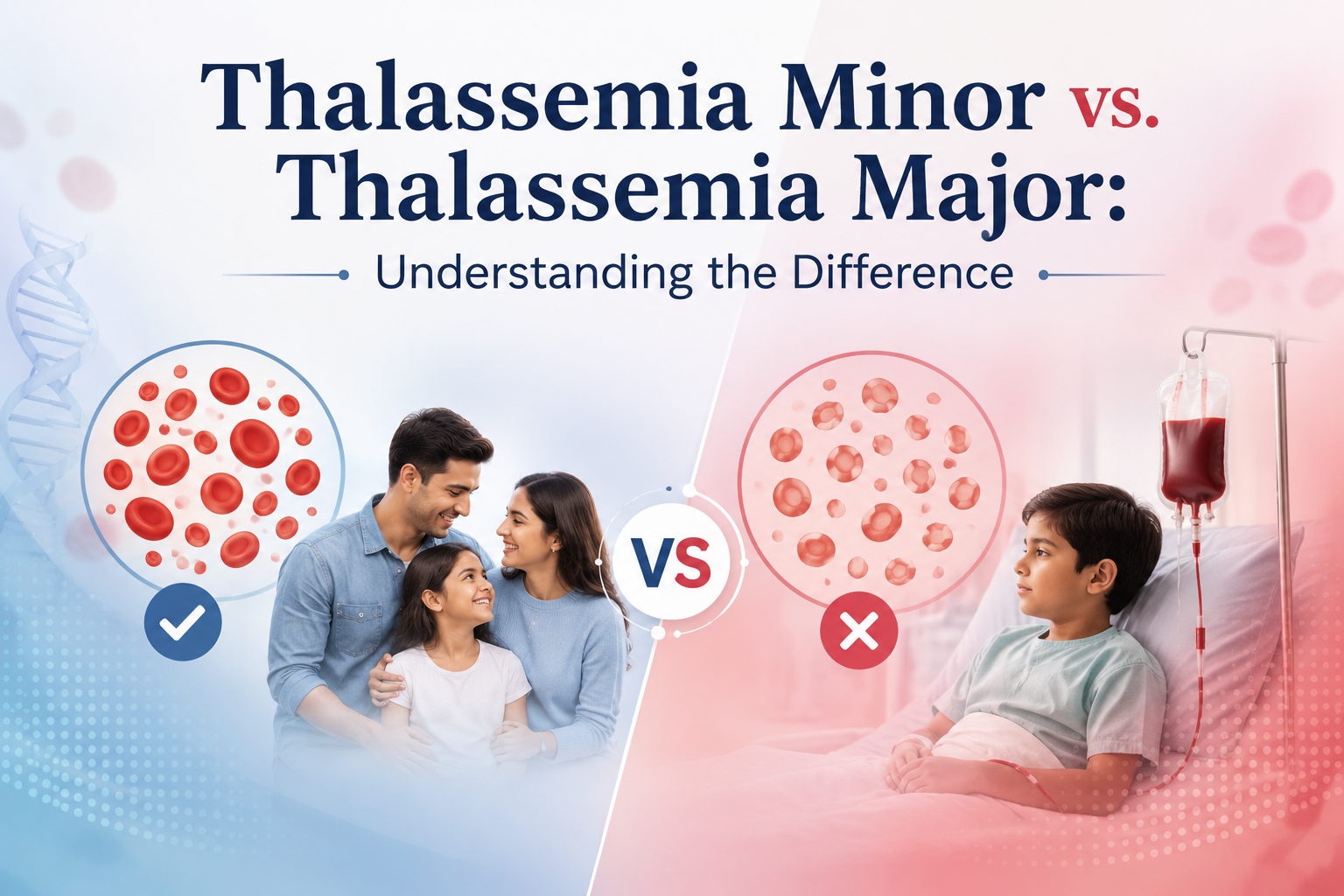
A blood test report comes back, and somewhere in the results is a line that says “thalassemia trait” or “thalassemia minor.” For most parents, this single phrase triggers a flood of questions. Is this the same as the thalassemia they’ve heard about, where children need lifelong blood transfusions? Does their child need treatment right away? Did they do something wrong during pregnancy?
The honest answer is that thalassemia minor and thalassemia major, despite sharing a name, are two very different situations — one usually requires no treatment at all, and the other requires lifelong medical care. Understanding this difference clearly is often the single most reassuring thing a parent can learn after a confusing report.
Why This Confusion Is So Common
Thalassemia is a genetic condition, which means the terminology around it is genetic terminology — carrier, trait, minor, major, homozygous, heterozygous. None of this is intuitive if you’re hearing it for the first time, often at a stressful moment like a pregnancy screening or a school health checkup. Add to that the fact that both minor and major forms show up as “abnormal” on a basic blood report, and it’s easy to see why parents assume the worst.
What Is Thalassemia, in Simple Terms?
Thalassemia is an inherited blood disorder that affects how the body produces hemoglobin — the protein in red blood cells responsible for carrying oxygen. It happens because of a change (mutation) in one of the genes involved in hemoglobin production. Depending on how many of these genes are affected and how significantly, thalassemia can range from a condition with no noticeable symptoms to one that is life-threatening without ongoing treatment.
The two forms most parents encounter are thalassemia minor (also called thalassemia trait) and thalassemia major.
Thalassemia Minor (Trait): What It Actually Means
A person with thalassemia minor has inherited one altered gene and one normal gene related to hemoglobin production. This is often described as being a “carrier.” Because one gene is still working normally, the body usually produces enough functional hemoglobin to carry oxygen effectively.
Most people with thalassemia minor:
- Have no symptoms at all, or at most mild, borderline anemia
- Live entirely normal, healthy lives
- Are often only discovered through a routine blood test, not because they felt unwell
- Do not require blood transfusions or specific thalassemia treatment
Does Thalassemia Minor Need Treatment?
In the vast majority of cases, no. Thalassemia minor is not a disease that needs to be “treated” the way an illness would be. It’s a genetic trait. The main clinical relevance of thalassemia minor isn’t for the person who carries it — it’s for family planning, because of what can happen if two carriers have a child together, which we’ll come to shortly.
Occasionally, mild anemia associated with thalassemia minor is mistaken for iron-deficiency anemia, and it’s worth knowing that iron supplementation doesn’t correct thalassemia-related anemia and isn’t usually needed or recommended unless a separate iron deficiency is also confirmed.
Thalassemia Major: A Different Condition Altogether
Thalassemia major occurs when a child inherits two altered genes — one from each parent, both of whom are usually carriers of thalassemia minor themselves (though they may have no idea, since minor is often symptomless). With both copies of the gene affected, the body cannot produce enough normal hemoglobin, leading to severe anemia.
When Symptoms of Thalassemia Major Usually Appear
Unlike thalassemia minor, thalassemia major does not stay silent. Symptoms typically begin to appear within the first six months to two years of a child’s life and can include:
- Pale skin and visible fatigue or lethargy
- Poor feeding and slow weight gain
- Yellowing of the skin or eyes (jaundice)
- An enlarged spleen or liver, sometimes noticeable as abdominal swelling
- Slower-than-expected growth and development
Children with thalassemia major require regular blood transfusions, usually every few weeks, to maintain adequate hemoglobin levels. Over time, this leads to iron buildup in the body, which needs to be managed with iron chelation therapy. For many children, a bone marrow transplant offers the possibility of a cure, and this is something families are often guided toward once the diagnosis is confirmed and a suitable donor is identified.
How Are Minor and Major Diagnosed Differently?
Both conditions are usually first flagged through a complete blood count (CBC), which may show smaller-than-normal red blood cells and mild-to-moderate anemia in the case of thalassemia minor, or significant anemia in thalassemia major. A test called hemoglobin electrophoresis, along with sometimes genetic testing, is used to confirm the specific type and distinguish trait from disease.
For thalassemia major, diagnosis is usually confirmed early — either through newborn screening programs where available, or once a baby begins showing symptoms in infancy. Thalassemia minor, on the other hand, is frequently picked up incidentally — during a pregnancy checkup, a premarital screening, a school health camp, or even a general health checkup for an unrelated reason.
If Both Parents Have Thalassemia Minor — What Does That Mean for Their Child?
This is the single most important reason thalassemia minor matters clinically, even though it causes no illness on its own. If both parents carry the thalassemia trait, each pregnancy carries:
- A 25% chance the child will have thalassemia major
- A 50% chance the child will be a carrier (thalassemia minor), like the parents
- A 25% chance the child will be entirely unaffected, with no altered gene at all
This is why genetic counseling is recommended for couples where both partners are found to be carriers, ideally before or early in a pregnancy, so that informed decisions can be made about prenatal testing and planning.
Why Premarital and Antenatal Screening Matters
Thalassemia is particularly common in certain populations, including parts of India, the Mediterranean, the Middle East, and Southeast Asia. Because thalassemia minor typically causes no symptoms, many carriers have no idea they carry the trait until a screening test reveals it — often at a point where the information matters most, such as before marriage or early in a pregnancy.
Simple, low-cost blood tests can identify carriers well before a couple decides to have children, giving families the opportunity to understand their risk and make informed choices, rather than discovering the diagnosis only after a baby is born with thalassemia major.
Living with Thalassemia Minor: What Parents Should Know
If your child has been diagnosed with thalassemia minor, the most important takeaway is reassurance: this is not a disease that will progress, worsen, or require ongoing treatment. What it does mean is that when your child is older and considering starting their own family, they should be aware of their carrier status and consider screening for their partner as well, so the same information is available to the next generation.
A Note From Dr. Vikas Dua
Dr. Vikas Dua, Principal Director & Head – Pediatric Hematology, Oncology & Bone Marrow Transplant at Fortis Memorial Research Institute, Gurugram, observes that a significant number of parent consultations begin with confusion between thalassemia minor and major, often following a routine blood test. With over 20 years of experience managing pediatric blood disorders and performing bone marrow transplants for children with thalassemia major, his approach emphasizes clear genetic counseling for families, so that a diagnosis of thalassemia minor doesn’t cause unnecessary alarm, while thalassemia major is addressed with the urgency and long-term planning it requires.
Conclusion
Thalassemia minor and thalassemia major share a name and a genetic root, but they are clinically worlds apart. Minor is a symptomless trait that usually needs no treatment, while major is a serious, transfusion-dependent condition diagnosed early in life. The real value of understanding this difference lies in what it means for the next generation — carrier screening, genetic counseling, and informed family planning can make a meaningful difference for future pregnancies.
If your child’s blood report mentions thalassemia trait or minor, or if you have concerns about thalassemia major symptoms, it’s worth discussing the specific report with a pediatric hematologist who can interpret it in the context of your child’s overall health.
Frequently Asked Questions
Q1. Is thalassemia minor the same as thalassemia trait? Yes, thalassemia minor and thalassemia trait refer to the same thing — a person who carries one altered thalassemia gene and one normal gene, usually without symptoms.
Q2. Can thalassemia minor turn into thalassemia major later in life? No. Thalassemia minor is a fixed genetic trait present from birth and does not progress or turn into thalassemia major over time.
Q3. Does a child with thalassemia minor need blood transfusions? No, thalassemia minor does not require blood transfusions. Only thalassemia major, where both hemoglobin genes are affected, typically requires regular transfusions.
Q4. How do I know if I am a thalassemia carrier? A simple blood test, usually a complete blood count followed by hemoglobin electrophoresis, can confirm carrier status. This is often recommended before marriage or early in pregnancy, especially in regions with higher thalassemia prevalence.
Q5. If I have thalassemia minor, will my child definitely have it too? Not necessarily. If only one parent carries the trait, each child has roughly a 50% chance of being a carrier and a 50% chance of being unaffected. The risk of thalassemia major only arises when both parents are carriers.
Q6. Can thalassemia major be cured? Bone marrow transplant offers the possibility of a cure for many children with thalassemia major, particularly when performed with a well-matched donor. Without transplant, thalassemia major is managed lifelong with regular transfusions and iron chelation therapy.
Q7. Is thalassemia minor dangerous during pregnancy? Thalassemia minor itself is generally not dangerous during pregnancy, though mild anemia may need monitoring. The bigger consideration is checking whether the partner is also a carrier, due to the implications for the baby.
This article is intended for general educational purposes and should not replace personalized medical advice. If you or your child has received a thalassemia-related blood test result, please consult a qualified pediatric hematologist for interpretation specific to your situation.
Dr. Vikas Dua Principal Director & Head – Pediatric Hematology, Oncology & Bone Marrow Transplant Fortis Memorial Research Institute, Gurugram
📞 +91-9818265787 / +91-8860760993 📍 Fortis Memorial Research Institute, Sector 44, Opposite HUDA City Centre, Gurugram, Haryana 122002 🌐 www.drvikasdua.com
