
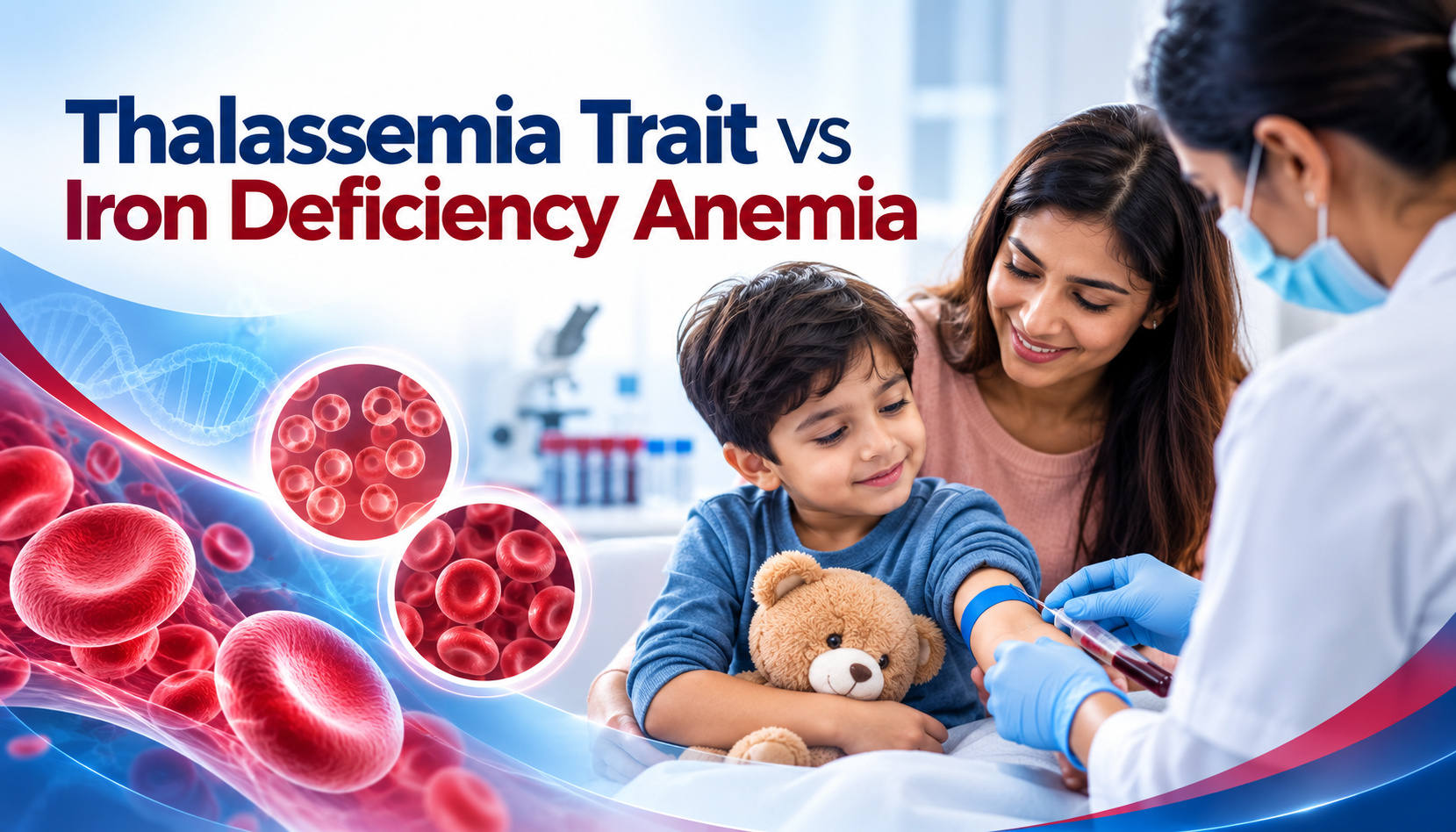
When a child’s blood test shows low hemoglobin or small red blood cells, one of the first possibilities doctors consider is anemia. For many parents, the immediate assumption is that the child simply needs more iron.
But not every small red blood cell is caused by iron deficiency.
Thalassemia trait is another important reason a child may have small red blood cells or mild anemia. Unlike iron deficiency, thalassemia trait is an inherited genetic condition. The two conditions can look similar on a routine complete blood count (CBC), yet they have different causes and require different approaches.
Understanding the difference between thalassemia trait and iron deficiency anemia can help parents avoid unnecessary worry—and, importantly, avoid assuming that every child with mild anemia needs iron supplements.
Dr. Vikas Dua’s thalassemia resource for children explains that evaluation may involve CBC, hemoglobin studies and, when appropriate, genetic testing.
What Is Iron Deficiency Anemia in Children?
Iron is an essential mineral needed to make hemoglobin, the protein inside red blood cells that carries oxygen throughout the body.
When a child does not have enough available iron, the body may produce fewer red blood cells and cells may become smaller and contain less hemoglobin. This can eventually result in iron deficiency anemia.
Children may develop iron deficiency for several reasons, including inadequate dietary iron, increased requirements during periods of rapid growth, restricted diets, or blood loss. The underlying reason matters, particularly when anemia persists or returns.
Symptoms can vary according to the severity and speed of development of anemia. Some children may have:
- Pale skin
- Tiredness or low energy
- Weakness
- Headaches
- Irritability
- Difficulty concentrating
- Reduced exercise tolerance
- Shortness of breath when anemia is significant
However, mild anemia may cause few noticeable symptoms.
The important point for parents is that anemia is a finding, not a diagnosis. A blood test showing low hemoglobin does not automatically tell you why it is low.
What Is Thalassemia Trait?
Thalassemia is an inherited blood disorder affecting hemoglobin production. Thalassemia trait, also called thalassemia minor, generally occurs when a child inherits one altered hemoglobin-related gene.
Most children with thalassemia trait are healthy and may have no obvious symptoms. Some may have mild anemia or smaller-than-usual red blood cells discovered incidentally during a routine blood test.
This is very different from severe forms of thalassemia that can cause significant anemia and require ongoing medical care.
Dr. Vikas Dua’s existing article on thalassemia minor versus thalassemia major explains that thalassemia minor is generally a carrier state and does not simply progress into thalassemia major later in life.
This distinction is important because parents sometimes hear the word thalassemia and immediately associate it with severe, transfusion-dependent disease.
Thalassemia trait is not the same as thalassemia major.
Thalassemia Trait vs Iron Deficiency Anemia: What Is the Difference?
The two conditions can look similar on a CBC because both may cause microcytosis, meaning red blood cells are smaller than usual.
But their underlying causes are completely different.
| Feature | Thalassemia Trait | Iron Deficiency Anemia |
|---|---|---|
| Main cause | Inherited genetic change affecting hemoglobin production | Insufficient available iron |
| Inherited? | Yes | Usually no |
| Red blood cell size | Often small | Often small |
| Hemoglobin | Normal or mildly reduced | May be reduced |
| Iron stores | Usually normal unless iron deficiency also exists | Often reduced |
| Ferritin | Usually normal if iron stores are adequate | Often low |
| Hemoglobin electrophoresis | May help identify certain thalassemia traits | Usually does not diagnose iron deficiency |
| Genetic testing | Sometimes useful | Not routinely required |
| Iron supplementation | Only if iron deficiency is also present | May be recommended when deficiency is confirmed |
| Long-term significance | Important for carrier status and family planning | Identifying and correcting the cause is important |
This table is a guide rather than a diagnostic tool. Doctors interpret blood results according to the child’s age, symptoms, medical history and the complete pattern of laboratory findings.
Why Can the CBC Look Similar?
This is one of the most confusing aspects for parents.
A CBC may show that a child’s red blood cells are smaller than average. This is often described as low MCV, or microcytosis.
Iron deficiency can produce this pattern because insufficient iron affects hemoglobin production.
Thalassemia trait can produce a similar pattern because the genetic change affects how hemoglobin is produced.
Therefore, looking at one CBC number alone is usually not enough to distinguish the two.
Doctors may examine several parameters together, including:
- Hemoglobin
- MCV
- MCH
- RBC count
- RDW
- Ferritin
- Other iron studies
- Peripheral blood smear
- Hemoglobin analysis
The overall pattern is more useful than focusing on a single value.
Can a Child Have Both Thalassemia Trait and Iron Deficiency?
Yes.
Having thalassemia trait does not protect a child from developing iron deficiency.
A child may inherit thalassemia trait and separately have low iron stores. In that situation, the blood picture can become more complicated.
This is one reason doctors should not automatically conclude that every child with microcytosis has thalassemia—or assume that every child with microcytosis simply needs iron.
A proper evaluation can help identify whether iron deficiency is actually present.
Which Tests Help Differentiate Thalassemia Trait and Iron Deficiency?
1. Complete Blood Count
The CBC is often the starting point.
Doctors may look at:
- Hemoglobin
- MCV
- MCH
- RBC count
- RDW
The pattern can suggest whether further investigation is necessary.
2. Ferritin and Iron Studies
Ferritin is commonly used to assess iron stores, although its interpretation can be affected by inflammation and other clinical factors.
Additional iron studies may sometimes be needed.
If iron stores are clearly low, iron deficiency becomes more likely.
3. Hemoglobin Electrophoresis or Other Hemoglobin Analysis
Hemoglobin analysis can help identify certain forms of thalassemia and other hemoglobin disorders.
The exact test required depends on what type of thalassemia or hemoglobin disorder is suspected.
4. Genetic Testing
Genetic testing may be useful in selected situations, particularly when the diagnosis remains uncertain or when understanding the precise inherited condition is important.
Dr. Vikas Dua’s article on genetic testing in pediatric cancers and blood disorders explains how genetic information can contribute to diagnosis and family counseling in inherited blood disorders.
Why Should Iron Not Be Given Automatically?
One common misconception is:
“My child’s hemoglobin is low, so my child must need iron.”
That conclusion is not always correct.
Iron is an important nutrient, but iron supplementation is most appropriate when iron deficiency has been identified or when a qualified clinician has determined that treatment is appropriate.
A child with thalassemia trait does not generally need iron simply because the red blood cells are small.
Unnecessary supplementation can distract from identifying the actual reason for the abnormal blood test.
The better approach is to understand why the hemoglobin or red blood cell indices are abnormal.
Does Thalassemia Trait Need Treatment?
In most cases, thalassemia trait itself does not require specific treatment.
Children with thalassemia trait can generally lead normal lives. The important issues are:
- Correctly identifying the carrier state.
- Avoiding unnecessary treatment for thalassemia itself.
- Detecting coexisting iron deficiency if present.
- Recording the carrier status for future medical care.
- Understanding its relevance to future family planning.
As Dr. Vikas Dua’s existing thalassemia article explains, thalassemia trait is fundamentally different from severe transfusion-dependent thalassemia.
Can Thalassemia Trait Become Thalassemia Major?
No.
A child with thalassemia trait does not gradually develop thalassemia major simply because they have the trait.
The distinction is genetic.
Thalassemia major occurs when a child inherits significant disease-causing changes from both parents, depending on the specific type of thalassemia involved.
This is why carrier identification can be important for families.
If both parents carry certain thalassemia traits, there can be a risk of having a child with a more severe form of the condition. Genetic counseling can help families understand their individual reproductive risk.
When Should Parents Consult a Pediatric Hematologist?
A pediatric hematologist may be helpful when a child’s anemia or abnormal CBC is persistent, unexplained or does not fit the expected pattern.
Parents should consider discussing the results with a specialist when:
- Hemoglobin remains low on repeated testing.
- MCV remains unusually low without an obvious explanation.
- Iron studies do not explain the anemia.
- There is a family history of thalassemia or another blood disorder.
- A child has been labelled as having “iron deficiency” repeatedly without improvement.
- There is a known thalassemia trait in the family.
- Multiple blood-cell types are abnormal.
- The child has unexplained fatigue, pallor or poor growth.
- A hemoglobin disorder is suspected.
A pediatric hematologist can look beyond one laboratory number and interpret the entire clinical picture.
Dr. Vikas Dua’s website also provides information about blood disorders in children, including thalassemia and other pediatric hematological conditions.
What If My Child Has Thalassemia Trait and Iron Deficiency?
This situation requires addressing the two issues separately.
If testing confirms iron deficiency, the child’s doctor may recommend appropriate iron replacement and investigate why the deficiency developed.
At the same time, the child’s thalassemia carrier status remains a genetic characteristic and does not disappear after iron levels are corrected.
Therefore, if the child continues to have small red blood cells after iron deficiency has been corrected, the underlying thalassemia trait may become more apparent.
The important lesson is that correcting iron deficiency and diagnosing thalassemia are two different clinical questions.
Why Family Screening Can Matter
Thalassemia is inherited, so identifying a child’s carrier status can provide useful information for the wider family.
Parents may benefit from discussing whether they themselves should undergo carrier testing, particularly when a child’s investigations suggest a hemoglobin disorder.
This becomes especially relevant later in life when the child reaches adulthood and considers having children.
The purpose of carrier screening is not to create fear. It is to give families accurate information so they can make informed decisions.
Frequently Asked Questions
Is thalassemia trait the same as iron deficiency anemia?
No. Thalassemia trait is an inherited genetic condition, while iron deficiency anemia occurs when the body does not have enough available iron to make adequate hemoglobin.
Can a child have both thalassemia trait and iron deficiency?
Yes. The two conditions can coexist. Appropriate testing is important because treating iron deficiency does not remove the child’s inherited thalassemia trait.
Does a child with thalassemia trait need iron supplements?
Not simply because they have thalassemia trait. Iron should generally be used when iron deficiency has been established or when a clinician has determined that supplementation is appropriate.
Which CBC findings suggest thalassemia trait?
Thalassemia trait may be associated with small red blood cells and mild anemia. However, CBC findings alone cannot reliably establish the diagnosis. Additional testing may be needed.
Is hemoglobin electrophoresis always required?
Not necessarily. The appropriate testing depends on the suspected type of hemoglobin disorder and the child’s overall laboratory and clinical picture.
Can thalassemia trait affect a child’s growth?
Most children with thalassemia trait are healthy and do not experience the severe growth problems associated with transfusion-dependent thalassemia. Persistent growth concerns should nevertheless be evaluated by a pediatrician.
Can thalassemia trait turn into thalassemia major?
No. Thalassemia trait is a genetic carrier state and does not progressively transform into thalassemia major.
When should my child see a pediatric hematologist?
Consider specialist evaluation when anemia is persistent or unexplained, when there is a family history of blood disorders, when blood-test abnormalities do not respond as expected to appropriate treatment, or when a hemoglobin disorder is suspected.
Final Takeaway for Parents
When a child’s blood report shows low hemoglobin or small red blood cells, iron deficiency is certainly one possibility—but it is not the only one.
Thalassemia trait can produce a similar blood-test pattern, and the two conditions require different approaches.
The distinction may involve looking at the CBC pattern together with iron studies, hemoglobin analysis and, in selected cases, genetic testing.
Most importantly, parents should not try to interpret a single CBC value in isolation. If anemia persists or the reason is unclear, a pediatrician or pediatric hematologist can help determine what the results actually mean.
For families seeking specialist evaluation of childhood blood disorders, Dr. Vikas Dua, Pediatric Hemato-Oncologist and Bone Marrow Transplant Specialist at Fortis Memorial Research Institute, Gurugram, provides care for children with a range of hematological conditions. His website includes dedicated resources on thalassemia and other pediatric blood disorders.
This article is for general educational purposes and should not replace an evaluation by a qualified healthcare professional.
