
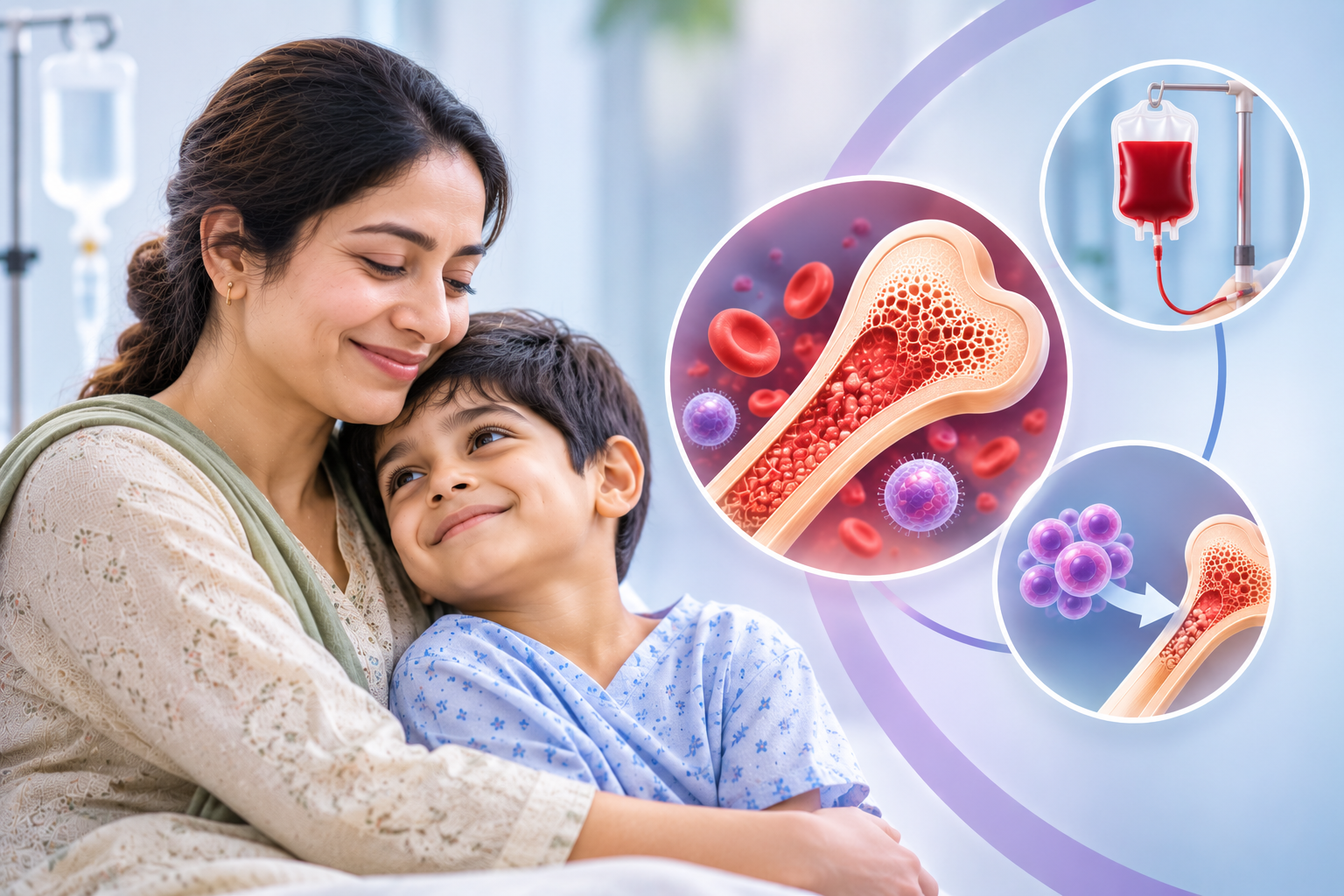
When a child is diagnosed with thalassemia major, parents usually hear two things in the same consultation. Your child will need blood transfusions every few weeks. And there is a way to cure this. Both statements are true, and the gap between them is where most of the confusion, and a lot of late-night Googling, begins.
This article walks through what each path really involves, who is a good candidate for a bone marrow transplant, and where the much-talked-about gene therapy stands for families in India right now. Thalassemia is one of the conditions we treat most often, and the questions below are the ones parents ask us again and again.
What thalassemia major means day to day
Thalassemia is an inherited condition in which the body cannot make enough healthy hemoglobin, the protein in red blood cells that carries oxygen. In thalassemia major, the most severe form, a child inherits a faulty gene from both parents. The bone marrow cannot keep up, and anemia sets in, usually within the first year or two of life.
Without regular transfusions these children become pale, weak and tired, grow poorly, and develop bone changes and an enlarged spleen. With transfusions, most children feel well enough to go to school and play. That is why transfusion has been the backbone of care for decades.
If your child has been told they have low hemoglobin and you are not sure whether it is thalassemia, our guide on thalassemia trait vs iron deficiency anemia explains how doctors tell the two apart.
The hidden cost of lifelong transfusions
Transfusions keep a child alive, but the body pays a quiet price. Each unit of blood carries iron, and the body has no natural way to get rid of the extra. Over the years it settles in the heart, liver and hormone-producing glands. Left unchecked, it can lead to heart problems, liver damage, delayed puberty, diabetes and thinning bones.
To prevent this, children take iron chelation medicines for years and have regular tests, such as serum ferritin and MRI scans, to keep an eye on iron levels. It works well when followed carefully. But it asks a lot of a family: hospital visits every two to four weeks, regular medicines, blood donor arrangements, missed school, missed work, and an expense that adds up year after year.
Bone marrow transplant: the only established cure today
A bone marrow transplant, also called a stem cell transplant, replaces the child’s faulty blood-forming cells with healthy ones from a donor. If the new cells take root, they start making normal red blood cells and the child no longer needs transfusions. Today it is the only widely available treatment that can cure thalassemia major.
“Cure” is a strong word, so let us be precise. For a child with a fully matched sibling donor, treated early and before serious iron damage, published results from experienced centers are generally very good, often in the range of 85 to 90 percent or higher. Outcomes are lower when the child is older, carries a heavy iron load, or already has liver or heart damage. That is why we like to evaluate children early, ideally in the first few years of life, rather than waiting for problems to appear. Dr. Dua will give you figures specific to your child after reviewing the reports.
Who is a good candidate?
There is no single age cut-off, but doctors look at several things together:
- Age. Younger children generally tolerate transplant better and have fewer accumulated complications.
- Iron overload and liver status. Ferritin levels and liver assessment help estimate risk.
- Quality of past care. How regularly transfusions and chelation have been done so far.
- Donor availability and type.
- General health, including infections and any other organ problems.
Older children and even young adults can still be considered, but the risks and the conversation are different, and each case needs an individual plan.
Finding the right donor
Donors are matched on HLA, a set of markers on white blood cells. The usual options are:
- Matched sibling donor. A brother or sister who is a full HLA match and does not have thalassemia major. This gives the best results. Each sibling has roughly a one in four chance of being a full match.
- Matched unrelated donor. Found through donor registries. The chance of finding one is lower for Indian patients because Indian donors are under-represented in global registries.
- Haploidentical (half-matched) donor. Usually a parent. Almost every child has one available. Better ways of preventing graft-versus-host disease have made this a real and increasingly common option, though results still depend on the experience of the center.
If your child has a sibling, ask for HLA typing early, even if you have not decided about transplant. It is simple and gives you information to plan with.
What the transplant journey looks like
Every hospital follows its own protocol, but the broad steps are similar:
- Work-up. Blood tests, infection screening, heart and organ assessments, and donor testing.
- Conditioning. A few days of chemotherapy to make room in the marrow so the new cells can settle in.
- Transplant day. The donor cells are given through a drip, much like a blood transfusion. It is usually uneventful.
- Waiting for engraftment. Over the next two to four weeks the new cells begin to produce blood. Immunity is very low during this time, so the child stays in a protected room.
- Recovery. The hospital stay often runs several weeks. After discharge, children need frequent follow-up, preventive medicines and caution with infections for months while the immune system rebuilds.
Parents are a big part of this. Children cope better when a calm, familiar face is with them, and we spend as much time preparing families as we do planning the medical side.
The risks, honestly
A transplant is a serious treatment, and anyone who tells you otherwise is not being straight with you. Risks include infections, graft failure, graft-versus-host disease (where donor cells attack the child’s tissues), mouth sores and nausea during conditioning, and, rarely, life-threatening complications. The conditioning can also affect fertility later in life, which is worth discussing early.
The real question is not whether a transplant has risks, but how those risks compare with a lifetime of transfusions and chelation, for this child, with this donor. That balance is different for every family, which is why we recommend a proper evaluation rather than a general opinion.
What about gene therapy?
You may have read headlines about gene therapy “curing” thalassemia. Some of these therapies have been approved in the United States and Europe. They work by correcting the child’s own stem cells in a laboratory and returning them. Early results are encouraging. But they are extremely expensive and, as of now, not routinely available in India. Indian research groups are working on their own gene-editing approaches, and these are still at an early stage.
So gene therapy is a hopeful development, not a reason to delay a decision today. For a child with a matched donor and good health, waiting for something that may be years away can mean more iron damage in the meantime. We would rather you know your options now and revisit the question as the field moves. We cover newer cell therapies in our article on CAR-T cell therapy in India.
Three practical steps before you decide
- Get HLA typing done for siblings early, even if you are not ready to decide.
- Keep a record of transfusion dates, hemoglobin before each transfusion, ferritin reports and the chelation your child has taken. It helps the transplant team assess risk.
- Ask about cost and support. Transplant is a significant expense, and there are donor options, schemes and financial help to explore. We have written about this in our guide to bone marrow transplant cost in India.
If thalassemia runs in your family, genetic counselling and carrier testing before the next pregnancy, and prenatal testing during it, can help prevent another child from being born with the severe form.
Talk to us
Dr. Vikas Dua is a pediatric hematologist-oncologist and BMT specialist, and Head of Pediatric Hematology, Oncology and Bone Marrow Transplant at Fortis Memorial Research Institute, Gurugram, with more than 20 years of experience. He has performed many transplants for children with thalassemia, including children from other countries. Read more about Dr. Dua, or book a consultation. Bring your child’s blood reports and transfusion history so we can give you a clear opinion at the first visit.
This article is for general information and does not replace medical advice. Please consult a doctor about your child’s condition.
