
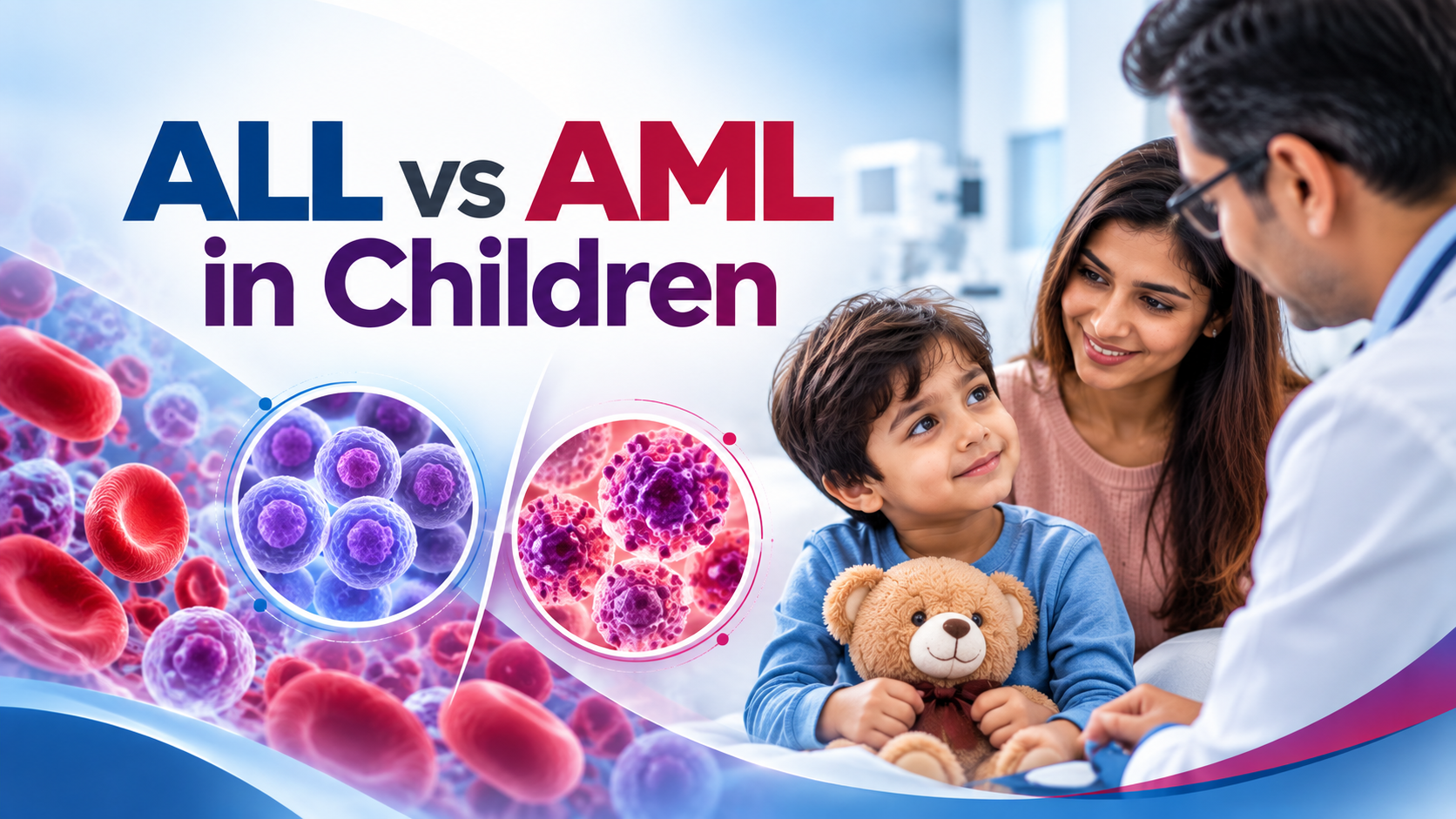
Hearing the words ALL or AML after a child’s blood tests or bone marrow examination can be frightening for parents. Both are forms of acute leukemia, but they are not the same disease.
ALL stands for Acute Lymphoblastic Leukemia, while AML stands for Acute Myeloid Leukemia. They arise from different blood-cell lineages, have different biological characteristics and may require different treatment approaches.
Understanding the difference between ALL vs AML in children can help parents make sense of medical discussions, diagnostic tests and treatment plans.
The good news is that pediatric leukemia treatment has advanced considerably. However, treatment needs to be individualized according to the exact leukemia subtype, genetic and molecular findings, risk classification and the child’s response to therapy.
What Is Childhood Leukemia?
Leukemia is a cancer involving the blood-forming tissues, particularly the bone marrow.
The bone marrow produces:
- Red blood cells
- White blood cells
- Platelets
In leukemia, abnormal blood-forming cells multiply in an uncontrolled way and can interfere with the production of normal blood cells.
The two major acute leukemia categories seen in children are:
- Acute Lymphoblastic Leukemia (ALL)
- Acute Myeloid Leukemia (AML)
ALL is the more common form of childhood leukemia, while AML is less common.
Although both are called “acute” leukemias, the word does not mean that one disease is necessarily more dangerous than the other. It refers broadly to a leukemia involving immature blood-forming cells that can progress rapidly without treatment.
What Is ALL in Children?
Acute Lymphoblastic Leukemia (ALL) develops from immature lymphoid cells, which are cells that would normally develop into certain types of lymphocytes.
ALL is the most common childhood leukemia.
Children with ALL can develop symptoms because abnormal leukemia cells crowd the bone marrow and interfere with normal blood-cell production.
Possible symptoms include:
- Persistent or recurrent fever
- Tiredness and weakness
- Pale skin
- Easy bruising
- Bleeding
- Recurrent infections
- Bone or joint pain
- Enlarged lymph nodes
- Abdominal fullness or swelling
- Reduced appetite
- Unexplained weight loss
These symptoms are not specific to leukemia. Many common childhood illnesses can cause similar complaints, which is why diagnosis requires appropriate medical evaluation.
What Is AML in Children?
Acute Myeloid Leukemia (AML) develops from abnormal immature cells of the myeloid blood-cell lineage.
AML is less common than ALL in children and has different biological and clinical characteristics.
Like ALL, AML can interfere with the normal production of red blood cells, white blood cells and platelets.
Children may therefore experience:
- Fatigue
- Pallor
- Fever
- Recurrent infections
- Easy bruising
- Bleeding
- Bone or joint discomfort
- Enlarged lymph nodes
- Reduced appetite
- Abdominal enlargement in some cases
The symptoms of AML can overlap considerably with ALL.
This is why symptoms alone cannot tell parents whether a child has ALL or AML.
ALL vs AML in Children: Key Differences
| Feature | ALL | AML |
|---|---|---|
| Full name | Acute Lymphoblastic Leukemia | Acute Myeloid Leukemia |
| Cell lineage | Lymphoid | Myeloid |
| Frequency in childhood | More common | Less common |
| Typical age distribution | Particularly common in younger children | Can occur across childhood |
| Diagnosis | CBC, smear, bone marrow, flow cytometry and molecular/cytogenetic studies | CBC, smear, bone marrow, flow cytometry and molecular/cytogenetic studies |
| Treatment | Risk-adapted chemotherapy with selected targeted/immunotherapy approaches | Intensive, subtype- and risk-adapted therapy |
| CNS-directed treatment | Commonly incorporated into treatment | Also important in appropriate cases |
| Stem-cell transplant | Used in selected high-risk or relapsed cases | May be considered for selected higher-risk or relapsed disease |
| Prognosis | Depends on subtype, risk and treatment response | Depends on subtype, genetics, risk and treatment response |
This comparison is intentionally simplified. Modern leukemia classification uses detailed genetic, molecular and immunophenotypic information rather than relying only on whether leukemia is labelled ALL or AML.
Are the Symptoms of ALL and AML Different?
There is considerable overlap.
Both can affect the bone marrow and interfere with the production of healthy blood cells. As a result, a child with either disease may develop:
Anemia-related symptoms
When red blood-cell production is reduced, children may become:
- Pale
- Tired
- Weak
- Less active
- Short of breath with exertion
Low platelet-related symptoms
When platelet production is affected, a child may experience:
- Easy bruising
- Nosebleeds
- Bleeding gums
- Small red or purple spots on the skin
Low or abnormal white blood cells
Children may experience:
- Fever
- Recurrent infections
- Persistent illness
Bone marrow involvement
Some children may experience:
- Bone pain
- Joint pain
- Limping
- Reduced willingness to participate in normal activities
The important point is that none of these symptoms by itself establishes a diagnosis of leukemia.
How Are ALL and AML Diagnosed?
Diagnosis requires more than a routine blood test.
1. Complete Blood Count
A CBC provides information about:
- Hemoglobin
- White blood cells
- Platelets
- Red blood-cell indices
An abnormal CBC may raise suspicion but usually cannot determine the exact leukemia subtype.
2. Peripheral Blood Smear
A blood smear allows doctors to examine blood cells under a microscope.
It may provide clues about abnormal or immature blood cells.
3. Bone Marrow Examination
A bone marrow aspiration and/or biopsy may be required to establish the diagnosis and characterize the leukemia.
The bone marrow contains the cells from which the leukemia originates, making this examination an important part of diagnosis.
4. Flow Cytometry
Flow cytometry helps identify specific proteins and characteristics on abnormal cells.
This can help determine whether the leukemia has a lymphoid or myeloid origin and can further classify the disease.
5. Cytogenetic and Molecular Testing
Genetic and molecular testing has become increasingly important in pediatric leukemia.
These tests can identify chromosome changes, gene alterations and other biological characteristics that may influence classification, risk assessment and treatment decisions.
6. Lumbar Puncture
A lumbar puncture may be performed when clinically appropriate to evaluate the central nervous system and, in some treatment protocols, to deliver therapy directly into the cerebrospinal fluid.
How Is ALL Treated?
Treatment for ALL is generally delivered through carefully planned phases.
The exact treatment depends on factors such as:
- Age
- Initial disease characteristics
- Genetic and molecular findings
- Leukemia subtype
- Response to early treatment
- Minimal residual disease assessment
- Overall risk classification
Treatment may include combinations of chemotherapy and, for selected subtypes or circumstances, targeted therapy or immunotherapy.
Treatment is generally designed not only to eliminate detectable leukemia cells but also to reduce the risk of relapse.
Because ALL treatment can extend over a prolonged period, children and families also require careful supportive care throughout therapy.
How Is AML Treated?
AML treatment is also individualized but generally involves intensive treatment designed to eliminate leukemia cells.
Depending on the specific AML subtype and risk classification, treatment may include:
- Intensive chemotherapy
- Targeted therapy for selected molecular abnormalities
- Supportive transfusions
- Infection prevention and treatment
- Other specialized therapies
- Stem-cell transplantation for selected children
AML is biologically diverse. Therefore, two children with AML may not necessarily receive exactly the same treatment.
Modern pediatric oncology increasingly uses genetic and molecular information to refine treatment decisions.
Does Every Child With Leukemia Need a Bone Marrow Transplant?
No.
This is one of the most important questions parents ask after a leukemia diagnosis.
A bone marrow transplant, also called a hematopoietic stem cell transplant, is not automatically required for every child with ALL or AML.
Whether transplant is considered depends on factors such as:
- Leukemia subtype
- Genetic and molecular characteristics
- Initial risk classification
- Response to treatment
- Minimal residual disease
- Relapse
- Availability of a suitable donor
- Overall health and treatment considerations
Parents can learn more about bone marrow transplant in children, including the procedure and recovery process.
When Might Transplant Be Considered?
Transplant may become an important treatment option in certain higher-risk or relapsed leukemias.
For example, a transplant team may consider it when the child’s leukemia has characteristics associated with a higher risk of relapse or when the disease returns after previous treatment.
However, the decision is complex.
Doctors weigh the potential benefits against the risks of transplantation and consider the child’s individual disease biology and treatment response.
This is why parents should be cautious about general statements such as “ALL always needs chemotherapy” or “AML always needs a transplant.”
Real-world treatment decisions are more nuanced.
Why Accurate Leukemia Classification Matters
Knowing whether leukemia is ALL or AML is only the beginning.
Modern pediatric leukemia care involves increasingly detailed classification.
Doctors may need to understand:
- The cell lineage
- Immunophenotype
- Chromosomal changes
- Molecular abnormalities
- Disease burden
- Treatment response
- Minimal residual disease
This information helps the medical team determine how aggressively the disease needs to be treated and whether additional treatment approaches should be considered.
Accurate classification can therefore directly influence treatment planning.
Is ALL Easier to Treat Than AML?
It is tempting to make a simple comparison and say that one type is always easier to treat.
That is not medically accurate.
ALL and AML are different diseases with different biology, treatment strategies and risk groups.
Many children with ALL achieve long-term remission, and outcomes for childhood leukemia have improved substantially with modern risk-adapted therapy.
AML can also be successfully treated, but treatment is generally intensive and requires specialized pediatric oncology care.
The most meaningful question is therefore not simply “Is ALL better than AML?”
Instead, parents should ask:
“What type of leukemia does my child have, what risk group does it belong to, and how is the disease responding to treatment?”
Can Childhood Leukemia Be Cured?
Many children with leukemia can achieve long-term remission and, depending on the disease and circumstances, cure.
However, it would be inappropriate to promise a particular outcome for an individual child.
Prognosis depends on multiple factors, including:
- Leukemia type
- Disease biology
- Genetic findings
- Age
- Initial disease burden
- Early treatment response
- Minimal residual disease
- Relapse status
- Overall health
Treatment should therefore be discussed with the child’s pediatric hematologist-oncologist, who has access to the complete clinical and laboratory picture.
Why Specialized Pediatric Leukemia Care Matters
Children are not simply small adults.
Their bodies are growing and developing, and leukemia treatment can affect nutrition, immunity, growth, development and other aspects of health.
Specialized pediatric hematology-oncology teams can coordinate:
- Cancer-directed treatment
- Infection management
- Blood-product support
- Nutritional care
- Psychosocial support
- Treatment monitoring
- Long-term follow-up
Frequently Asked Questions
Is ALL more common than AML in children?
Yes. ALL is the more common form of childhood leukemia, while AML is less common.
Are the symptoms of ALL and AML the same?
They can overlap considerably. Fever, fatigue, pallor, bruising, bleeding, infections and bone or joint pain can occur with both. Symptoms alone cannot establish which type of leukemia a child has.
Can a CBC diagnose ALL or AML?
A CBC can raise suspicion, but it generally cannot establish the complete leukemia classification. Additional tests such as bone marrow examination, flow cytometry and genetic or molecular studies may be required.
Does every child with AML need a bone marrow transplant?
No. Transplant is considered for selected children based on disease characteristics, risk, treatment response and other clinical factors.
Does every child with ALL need a transplant?
No. Many children with ALL are treated without transplantation. Transplant is considered only in selected situations.
Why are genetic tests performed in childhood leukemia?
Genetic and molecular testing can help classify leukemia, identify risk factors and guide treatment decisions.
Can childhood leukemia be cured?
Many children achieve long-term remission, and cure is possible for many forms of childhood leukemia. The expected outcome varies according to disease biology, risk and treatment response.
How long does leukemia treatment take?
Treatment duration varies considerably by leukemia type, treatment protocol, risk group and response. Parents should ask their child’s treating team for a timeline specific to the child’s diagnosis.
What Should Parents Ask After a Leukemia Diagnosis?
Once a child has been diagnosed, parents may feel overwhelmed by medical terminology.
Useful questions to ask the treating team include:
- Does my child have ALL or AML?
- What specific subtype has been identified?
- What do the genetic and molecular tests show?
- What risk group does my child’s leukemia fall into?
- What is the planned treatment approach?
- How will we know whether treatment is working?
- Will minimal residual disease be monitored?
- Is a bone marrow transplant being considered, and if so, why?
- What supportive care will my child need?
- What symptoms should make us contact the treatment team urgently?
These questions can help parents understand the reasoning behind the treatment plan rather than simply receiving a list of procedures.
Final Takeaway
ALL and AML are both acute childhood leukemias, but they are different diseases.
ALL arises from the lymphoid blood-cell lineage, while AML arises from the myeloid lineage. Their symptoms can overlap, so doctors rely on blood tests, bone marrow examination, flow cytometry and genetic or molecular studies to establish the diagnosis and guide treatment.
Importantly, not every child with ALL or AML needs a bone marrow transplant. Treatment decisions depend on the exact disease characteristics, risk classification and response to therapy.
For parents, the most useful step after a diagnosis is to understand the child’s specific leukemia subtype and treatment plan and to work closely with a specialized pediatric hematology-oncology team.
Dr. Vikas Dua is a Pediatric Hemato-Oncologist and Bone Marrow Transplant Specialist and serves as Principal Director and Head of Pediatric Hematology, Oncology and Bone Marrow Transplant at Fortis Memorial Research Institute, Gurugram. His website provides dedicated resources on childhood leukemia and pediatric bone marrow transplantation.
For consultation:
Fortis Memorial Research Institute, Sector 44, Opposite HUDA City Centre, Gurugram, Haryana 122002. The website lists OPD hours as Monday–Saturday, 9:00 AM–5:00 PM.
This article is intended for general educational purposes and should not replace individualized medical advice from a qualified pediatric hematologist-oncologist.
